Skip to content

Gear guide · Updated August 4, 2026

The Best Sand Scoop for Metal Detecting

Short answer

The best sand scoop for metal detecting is a 316 stainless steel scoop with roughly 7mm holes — small enough to hold a thin gold chain, large enough to drain fast. Get a long handle if you hunt wet sand or surf, and a short hand scoop if you stay on dry sand.

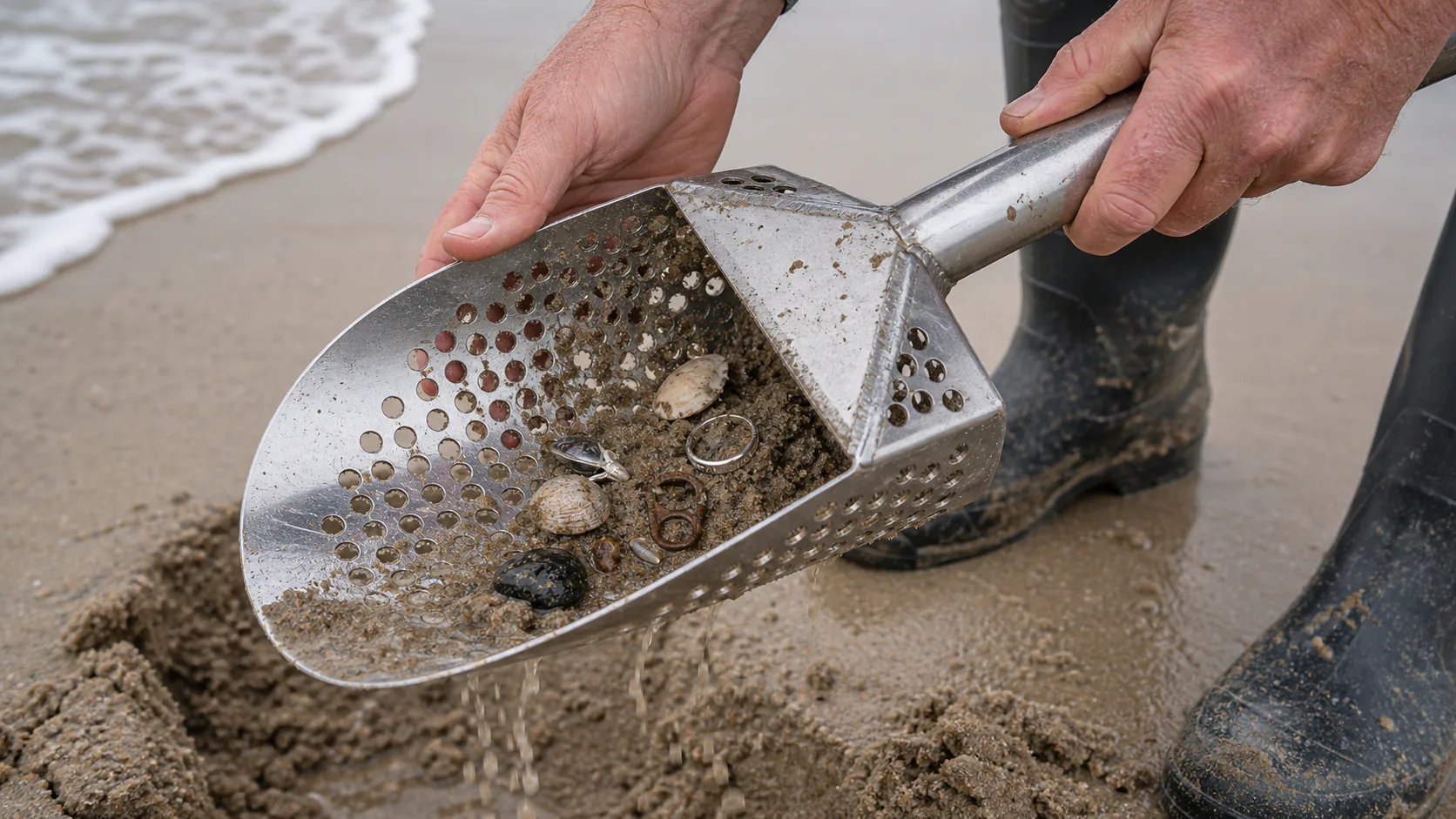
A sand scoop for metal detecting is a perforated basket that sifts sand out and leaves your target sitting in the bottom. The right one is 316 stainless steel with roughly 7mm holes — and the handle length is decided entirely by whether you hunt wet sand or dry.

This is the accessory that changes beach detecting most. Digging wet sand with a trowel is a losing fight: the hole refills faster than you can empty it. A scoop turns a two-minute wrestling match into one confident stab.

As an Amazon Associate I earn from qualifying purchases. If you buy through a link here I earn a small commission — at no extra cost to you. It pays for coil covers and gas money, and it never changes a verdict. Full disclosure.

01The picks at a glance

AwardWhat to buyThe spec that matters
Top pickLong-handle stainless scoopMid · the one most beach hunters end up with316 stainless · ~7mm holes · 40–50in handle
Best for dry sandShort hand scoopBudget · the cheapest thing that genuinely worksStainless or heavy plastic · ~20in overall
Best for surf and waterHeavy-duty surf scoopUpper mid · buy onceThick-gauge stainless · reinforced tip · drain-optimised holes
Best for travelTravel / breakdown scoopMidDetachable or telescoping handle
Best upgradeCarbon fibre handle upgradeAdd-onReplaces the stock handle · roughly half the weight

02Every pick, explained

01Top pick

Long-handle stainless scoop

316 stainless · ~7mm holes · 40–50in handle · Mid · the one most beach hunters end up with

This is the default answer for beach detecting. A stainless basket on a 40–50 inch handle lets you drive the scoop in with your foot and lift without bending — which matters enormously when you're doing it two hundred times in an afternoon.

The long handle is the whole point in wet sand and the surf line. You stand upright, punch down, lift, and shake. With a hand scoop in the same conditions you're bent double with a wave arriving.

Look for 316 stainless rather than 304 — it's the marine grade and it's what survives saltwater without pitting. Brands worth searching: CKG, RTG, Stealth, T-Rex, and Nokta.

02Best for dry sand

Short hand scoop

Stainless or heavy plastic · ~20in overall · Budget · the cheapest thing that genuinely works

If you hunt dry sand and grass, a hand scoop is enough — and it's a fraction of the price and weight. Dry sand doesn't collapse back into the hole, so you don't need the leverage a long handle gives you.

This is also the right scoop for a child. A long-handle steel scoop is genuinely too heavy for a 7-year-old to work; a small hand scoop they can actually lift keeps them digging.

The honest limitation: take it into wet sand and you'll be on your knees in the swash with water filling the hole. It's a dry-sand tool.

03Best for surf and water

Heavy-duty surf scoop

Thick-gauge stainless · reinforced tip · drain-optimised holes · Upper mid · buy once

In the surf you're fighting moving water, so the scoop has to drain fast and survive abuse. Heavy-gauge stainless with a reinforced leading edge is what holds up when you're driving it into packed wet sand and shell.

The trade-off is weight. A surf scoop is a genuinely heavy tool, and swinging a detector in one hand while carrying it in the other is tiring. That's fine for a dedicated water hunt, and overkill for a park.

Pair it with a machine that can actually handle wet salt sand — a single-frequency detector will false constantly there no matter how good your scoop is. See our beach and water roundup.

04Best for travel

Travel / breakdown scoop

Detachable or telescoping handle · Mid

A scoop with a removable handle fits in a suitcase. If you're the kind of detectorist who packs a machine for holidays, this is the difference between bringing a scoop and improvising with your hands.

Check the handle joint specifically — it's the failure point on every breakdown design. A threaded collar or a pinned lock holds up; friction-fit ones work loose in wet sand.

05Best upgrade

Carbon fibre handle upgrade

Replaces the stock handle · roughly half the weight · Add-on

If your arms are the limiting factor, swap the handle rather than the basket. A carbon fibre shaft on a stainless basket keeps the digging performance and drops a meaningful amount of weight.

Worth it if you hunt long sessions or have a bad shoulder. Not worth it if you're out for an hour on dry sand — the stock aluminium or steel handle is fine at that duration.

03How to choose

Hole size is the spec that actually matters

Everything else is comfort; hole size decides what you keep. Around 7mm is the sweet spot. It drains sand fast while still retaining a thin gold chain, which is the find you'd be most upset to lose through the basket.

Bigger holes (10mm+) drain faster and are tempting in wet sand, but a fine chain or a small stud earring goes straight through. Smaller holes hold everything and clog with shell grit — you end up shaking the scoop instead of hunting.

Long handle vs hand scoop: it's about wet sand, not preference

Wet sand and surf: long handle. The hole collapses and refills as you dig, so you need to drive the scoop deep in one movement and lift with your legs. Bending over to hand-dig wet sand two hundred times is how people quit beach detecting.

Dry sand, grass, and kids: hand scoop. Dry sand holds its shape, targets are shallow, and a light scoop is faster and far less tiring than swinging a five-foot pole around.

Plenty of people own both. If you're buying one and you're not sure, buy the long handle — it works on dry sand, just less elegantly.

Stainless, titanium, or plastic

316 stainless steel is the default and the right answer for most people. It's the marine grade, it survives saltwater with a rinse, and it's strong enough to lever against shell and packed sand.

Titanium is lighter and effectively immune to corrosion, and it costs several times as much. It's a genuine luxury upgrade for people who hunt saltwater constantly, not a necessity.

Plastic scoops are cheap and fine for children on dry sand. They flex and crack when you lever them against anything solid, so don't buy one expecting to work wet sand with it.

Whatever you buy, rinse it in fresh water after saltwater. Salt destroys scoops — and detectors — far faster than use does.

Scoop vs sifter vs shovel

A scoop is the beach tool: a basket you stab into loose sand that sifts as you lift. This is what you want at the coast.

A sifter is a screen you shake material through by hand — slower, but it catches very small items. Some prospectors use one for working a promising patch thoroughly.

A shovel or digging trowel is the dirt tool. On grass you cut a plug and put it back; a scoop would tear the turf apart and get sites closed to detectorists. Different job, different tool — see our digging tools notes.

04FAQ

What is the best sand scoop for metal detecting?
A 316 stainless steel scoop with roughly 7mm holes. Choose a 40–50 inch long handle if you hunt wet sand or surf, and a short hand scoop if you stay on dry sand and grass.
What size holes should a sand scoop have?
Around 7mm. That drains sand quickly while still retaining a thin gold chain. Holes of 10mm and up drain faster but let fine jewelry fall straight through.
Do I need a long handle sand scoop?
Only for wet sand and surf, where the hole refills as you dig and you need to punch deep and lift without bending. On dry sand a short hand scoop is faster and much lighter.
Is a stainless steel sand scoop worth it?
Yes, and specifically 316 stainless — it's the marine grade that survives saltwater without pitting. Plastic scoops flex and crack in wet sand; titanium is better but costs several times as much for a modest gain.
What's the difference between a sand scoop and a sand sifter?
A scoop is a basket you drive into loose sand and lift, sifting as it drains — it's the fast beach tool. A sifter is a screen you shake material through by hand, which is slower but catches very small items.
Can you use a sand scoop on grass or dirt?
No. On grass you cut and replace a plug with a trowel, which leaves the ground intact. A scoop tears turf up, and that's exactly what gets parks closed to detectorists.
How do you clean a sand scoop?
Rinse it in fresh water after every saltwater hunt, including the handle joint. Salt left to dry is what pits stainless and seizes breakdown handles.

Keep reading

Detectors to pair it with

  • Minelab Equinox 800 review

    One detector to cover coins, jewelry, beach, and the occasional gold hunt — without compromising on any of them.

  • Nokta Simplex+ review

    Beginners and second-machine buyers who want waterproof capability — creeks, lakes, rain, and freshwater swim beaches.

More gear guides

  • The Best Metal Detecting Shovel and Digging Tools

    The best metal detecting shovel is a serrated-edge steel shovel with a full tang — the serration is what gets you through roots and compacted soil. Use a long-handle shovel for open ground and deep targets, and a hand digger for tidy plugs in mown grass.

Buying guides

  • Best Pinpointers for Metal Detecting

    The best pinpointer for metal detecting is the Garrett Pro-Pointer AT — waterproof, adjustable, and hard to lose. Probes compared for dirt, water, and gold.

  • Best Pinpointer Metal Detector for Gold

    The best pinpointer for gold is the Falcon MD20 — a very high frequency probe that finds flakes in quartz standard pinpointers miss. Gold probes compared.

  • Best Metal Detector for Kids

    The best metal detector for kids is the Nokta Mini Hoard — light enough for a small child and capable enough to find real coins. Picks by age, from 5 to teenager.