Skip to content

Buying guide · Updated August 4, 2026

Best Metal Detector for Kids

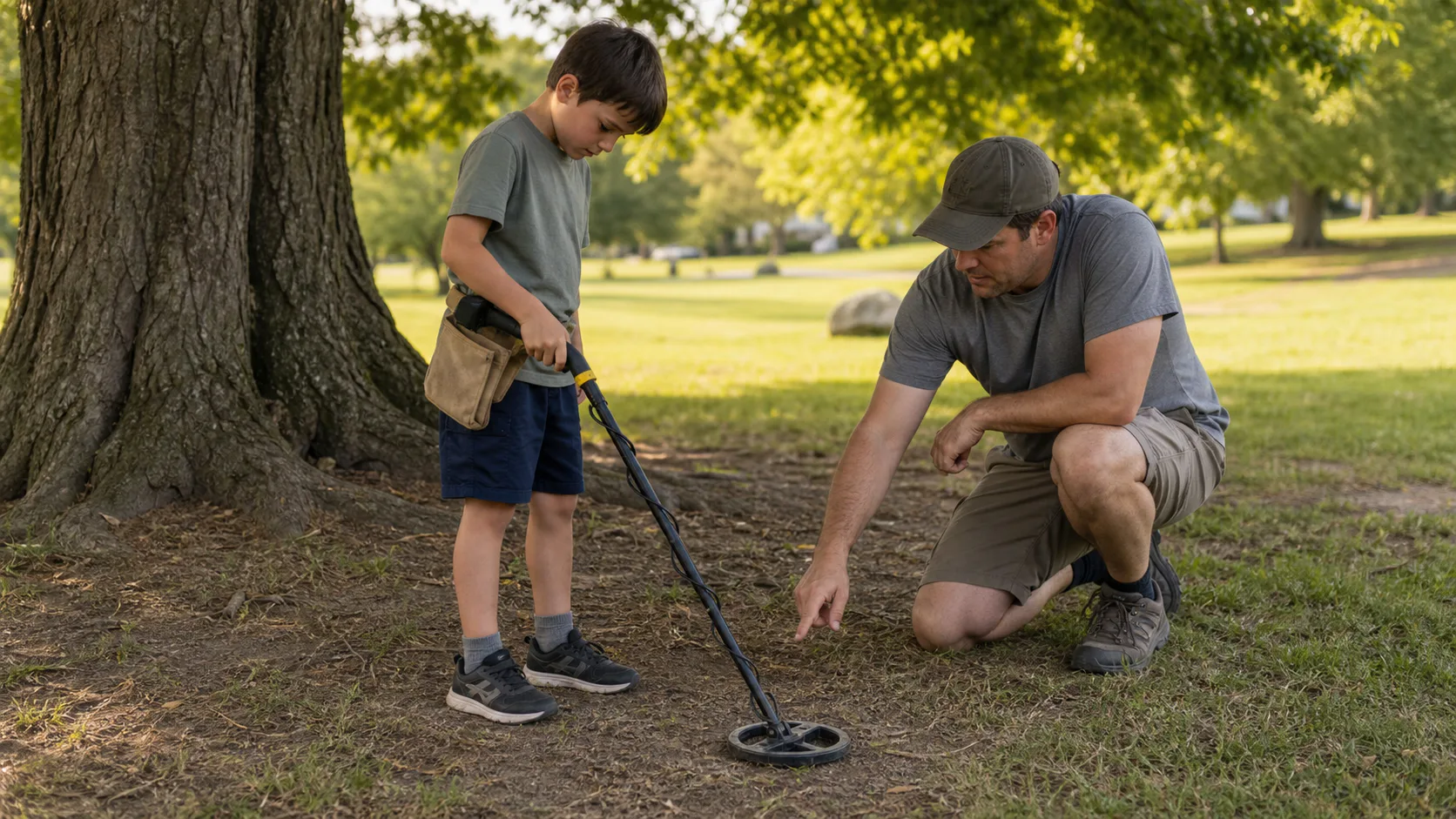
The best metal detector for kids is the Nokta Mini Hoard: it's light enough for a small child to actually swing, it has a real target ID screen, and it finds genuine coins rather than just beeping. For older kids around 8 to 12, step up to the Nokta Midi Hoard; for teenagers, buy an adult machine.

Here's the thing that decides this purchase, and it isn't depth: weight. A detector a child can't comfortably swing gets handed to you after ten minutes and then lives in the garage. Every recommendation below starts there.

As an Amazon Associate I earn from qualifying purchases. If you buy through a link here I earn a small commission — at no extra cost to you. It pays for coil covers and gas money, and it never changes a verdict. Full disclosure.

01The picks at a glance

AwardDetectorRatingBest for
Top pick · ages 5–9Nokta Mini HoardEntry-level4.5Children roughly 5 to 9, hunting parks, gardens, and dry beaches with an adult nearby.
Best for ages 8–12Nokta Midi HoardEntry-level4.0Children roughly 8 to 12 who are past a toy detector but not ready for the weight of an adult machine.
Cheapest that actually worksBounty Hunter Junior (BHJS)Budget3.5Testing the water — a birthday gift for a child who might be interested, without committing real money.
Best for teenagersGarrett Ace 400Entry-level4.0A first detector for parks, fields, and dry ground — someone who wants to be finding coins the same day it arrives.
Best teen upgradeNokta Simplex+Entry-level4.5Beginners and second-machine buyers who want waterproof capability — creeks, lakes, rain, and freshwater swim beaches.

02Our top pick

Nokta · Entry-level

Nokta Mini Hoard

The rare kids' detector that isn't a toy. Light enough for a small child and capable enough to find real coins.

Read the full Mini Hoard review →

03Every pick, explained

01Top pick · ages 5–94.5

Nokta Mini Hoard

Genuinely light, short enough in the shaft for a five-year-old, and fitted with a real target ID screen so a kid learns that iron reads low and coins read high. The whole machine is waterproof to 3 ft, so puddles and creek edges aren't a crisis.

It's the rare kids' detector that isn't a toy with a coil glued on. Read the full Nokta Mini Hoard review.

02Best for ages 8–124.0

Nokta Midi Hoard

Longer shaft, a bit more capability, and still well under the weight of an adult machine. This is the right size for the age where a kids' detector feels insulting but a 5-pound adult one is genuinely too much.

Be aware the useful window is a couple of seasons. Read the full Nokta Midi Hoard review.

04Best for teenagers4.0

Garrett Ace 400

Once a kid is around 13, stop buying kids' gear. The Ace 400 is turn-on-and-go simple, has a proper target ID, and will still be the right detector when they're twenty.

The one caveat is weight — at 5.5 lbs it's a real machine, so a harness helps. Read the full Garrett Ace 400 review.

05Best teen upgrade4.5

Nokta Simplex+

For a teenager who's clearly serious: fully waterproof to 10 feet, wireless headphones included, and light at 2.9 lbs. It removes the two things that end teenage hunts early — weight and worrying about the weather.

It's an adult machine, and that's the point. Read the full Nokta Simplex+ review.

04How to choose

Which age needs which detector

Ages 5–7: weight is everything. Look for something under about 2 lbs with a shaft that collapses genuinely short. Expect shallow finds and short sessions, and go with them. See our 5, 6, and 7 year old guide.

Ages 8–10: the sweet spot. Kids this age have the patience for a target ID screen and the arm strength for a youth-sized machine. This is where a detector genuinely becomes a hobby rather than a novelty. See the 8, 9, and 10 year old guide.

Ages 11–13: stop buying kids' gear. A real entry-level machine with the shaft collapsed fits fine and won't be outgrown. See the 11, 12, and 13 year old guide.

Teenagers: buy the adult detector you'd buy yourself. Anything branded for children will be resented, and rightly so. See the teenager guide.

Weight is the spec that decides everything

A child abandons a heavy detector fast, and no feature compensates. Under about 2 lbs for young children, under about 2.5 lbs up to age twelve, and adult weights only once they're big enough to carry a school bag comfortably for an hour.

Balance matters as much as raw weight. A nose-heavy 2-pound machine feels worse than a well-balanced 2.5-pound one, because the child is fighting leverage rather than mass.

Toy detectors vs real ones

The toy-aisle detectors — bright plastic, no screen, sometimes not even a real coil — beep at soda cans and nothing else. A child gets excited, finds nothing, and concludes detecting is boring. That's a worse outcome than not buying one.

The test is simple: does it have a target ID screen or at least a real discrimination control, and does it have a proper search coil? If not, it's a toy. See are toy metal detectors worth it.

Should you just buy an adult detector?

Often, yes — and it's the advice most parents don't hear. An entry-level adult machine like the Garrett Ace 400 collapses down reasonably short, has a proper target ID, and will still be right in five years. The only real barrier is weight.

The honest rule: under about nine, buy a kids' detector. Ten to twelve, it depends on the child's size and how serious they are. Thirteen and up, buy the adult machine.

What else to buy

A small digging trowel they can handle, gloves — non-negotiable, since they'll be handling rusted metal and broken glass — and a pouch for trash as well as finds. Teaching a kid to carry out what they dig is how the hobby keeps its sites.

Skip the pinpointer at first. It's the best accessory in detecting for adults, but a young child recovering shallow targets doesn't need one yet.

Where to take them

Your own garden first — salt a patch with a few coins so the first session is a guaranteed success. Then local parks, school fields out of hours where permitted, and dry beach sand, which is the single best kids' hunting ground because targets are shallow and easy to dig.

Check the rules before you go. Many parks are fine, some require a permit, and national parks prohibit detecting entirely. Fill every hole, whoever dug it.

05FAQ

What is the best metal detector for kids?
The Nokta Mini Hoard for children roughly 5 to 9 — it's light, has a real target ID screen, and finds genuine coins. For 8 to 12, the Midi Hoard; for teenagers, an adult machine like the Garrett Ace 400.
What's a good metal detector for a child?
One under about 2 lbs with a shaft that collapses short and a target ID screen. Those three things matter far more than depth at this age — a child who can't comfortably swing it won't use it twice.
How much should I spend on a kids' metal detector?
Around $50–80 for a basic one to test the interest, or $120–200 for one with a real target ID screen. Spending more than that on a child's machine rarely pays off, because they outgrow the form factor before they outgrow the capability.
What age can a child start metal detecting?
About 5 with an adult alongside them, and around 8 to do it semi-independently. The limiting factors are attention span and arm strength, not comprehension. See what age can a kid start metal detecting.
Are kids' metal detectors any good?
The properly engineered ones are — a Nokta Hoard will find real coins. The toy-aisle ones generally aren't, and they tend to put children off the hobby rather than into it.
Is a beginner metal detector the same as a kids' metal detector?
No. Beginner detectors are adult-sized machines with simple controls; kids' detectors are shorter and much lighter, with less capability. An adult beginner should buy a beginner machine, not a kids' one — see our beginner picks.
Is metal detecting safe for kids?
Yes, with basic supervision. The real risks are what they dig up — rusted metal, broken glass, and occasionally something sharp — so gloves are essential and an adult should handle anything unidentified. See are metal detectors safe for kids.

Keep reading

More buying guides

  • Best Pinpointers for Metal Detecting

    The best pinpointer for metal detecting is the Garrett Pro-Pointer AT — waterproof, adjustable, and hard to lose. Probes compared for dirt, water, and gold.

  • Best Pinpointer Metal Detector for Gold

    The best pinpointer for gold is the Falcon MD20 — a very high frequency probe that finds flakes in quartz standard pinpointers miss. Gold probes compared.

  • Best Metal Detector for Beginners

    The best metal detector for beginners is the Nokta Simplex+ — waterproof, wireless, and simple enough to use on day one. Starter, entry-level, and intermediate picks compared.

  • Best Metal Detector for Beach & Water

    The best metal detector for the beach is the Minelab Equinox 800 — multi-frequency handles wet salt sand and it's submersible to 10 feet. Waterproof and underwater picks compared.

Common questions

  • How Does a Metal Detector Work?

    A metal detector works by sending a pulsing magnetic field into the ground from its coil. Metal objects react to that field by generating their own weak field, and the detector hears that echo and turns it into a tone and a number on screen.

  • Can a Metal Detector Detect Gold?

    Yes. Any metal detector will find gold — gold is metal, and gold rings, chains, and coins show up on even entry-level machines. Finding small gold nuggets in mineralized goldfields is the hard version, and that needs a high-frequency or pulse-induction detector.

  • How Much Does a Metal Detector Cost?

    A metal detector costs about $100 for a basic starter, $200–400 for a genuinely capable entry-level machine, $500–800 for mid-range multi-frequency, and $1,000–1,500 for a flagship. Most people should spend $200–400.

Get better at this

  • How to Use a Metal Detector

    How to use a metal detector: ground balance it, swing slow and low, learn your target IDs, and dig everything at first. A complete beginner's field guide.