Skip to content

Buying guide · Updated August 5, 2026

Best Metal Detector for Beach & Water

The best metal detector for the beach is the Minelab Equinox 800: multi-frequency operation handles wet salt sand without falsing, and the whole machine is submersible to 10 feet. For freshwater and budget beach hunting, the Nokta Simplex+ does most of the job for far less.

Beach hunting punishes the wrong machine harder than any other environment. Wet salt sand is electrically conductive, and a single-frequency detector reads it as one giant target — you get a chattering, useless machine no matter how good it is on dirt.

As an Amazon Associate I earn from qualifying purchases. If you buy through a link here I earn a small commission — at no extra cost to you. It pays for coil covers and gas money, and it never changes a verdict. Full disclosure.

01The picks at a glance

AwardDetectorRatingBest for
Top pickMinelab Equinox 800Upper mid4.5One detector to cover coins, jewelry, beach, and the occasional gold hunt — without compromising on any of them.
Best budget waterproofNokta Simplex+Entry-level4.5Beginners and second-machine buyers who want waterproof capability — creeks, lakes, rain, and freshwater swim beaches.
Best for dry & damp sandMinelab Vanquish 540Mid-range4.0Beginners and casual hunters who want real multi-frequency depth and separation without menu diving.

02Our top pick

Minelab · Upper mid

Minelab Equinox 800

Still the smartest buy-once detector on the market. Learn its menu over a weekend and you'll never need a second machine.

Read the full Equinox 800 review →

03Every pick, explained

02Best budget waterproof4.5

Nokta Simplex+

Fully submersible to 10 feet at an entry-level price, with wireless headphones included. For freshwater lake beaches, creeks, and dry sand it's outstanding value.

Be clear on the limit: it's single frequency, so wet salt sand still causes falsing. Waterproof and salt-capable are two different things, and this machine is only the first one. Read the full Nokta Simplex+ review.

04How to choose

Why wet salt sand breaks most detectors

Saltwater conducts electricity. To a single-frequency detector, wet salt sand looks like a continuous sheet of metal — so it either chatters constantly or you crank discrimination up until it's deaf to good targets too.

Multi-frequency machines transmit several frequencies simultaneously and use the differences between the returns to separate the salt signal from real targets. That's the entire reason multi-frequency costs more, and on a salt beach it's non-negotiable.

Waterproof, submersible, and rain-resistant are three different claims

"Waterproof coil" is meaningless — every detector has one. What matters is the control box. Submersible machines state a depth rating (10 feet is typical) and can be taken into the water. Rain-resistant means it survives a drizzle and nothing more.

If you plan to wade past your knees, you need a stated submersion depth. And if you're going in the water, you also need waterproof headphones — standard ones will not survive, and on many machines they're a separate purchase.

Dry sand, wet sand, and the surf are three different hunts

Dry sand is the easiest: almost any machine works, targets are shallow, and it's where recently dropped jewelry sits. Wet sand below the tide line is where the older, heavier gold has settled — and where you need multi-frequency.

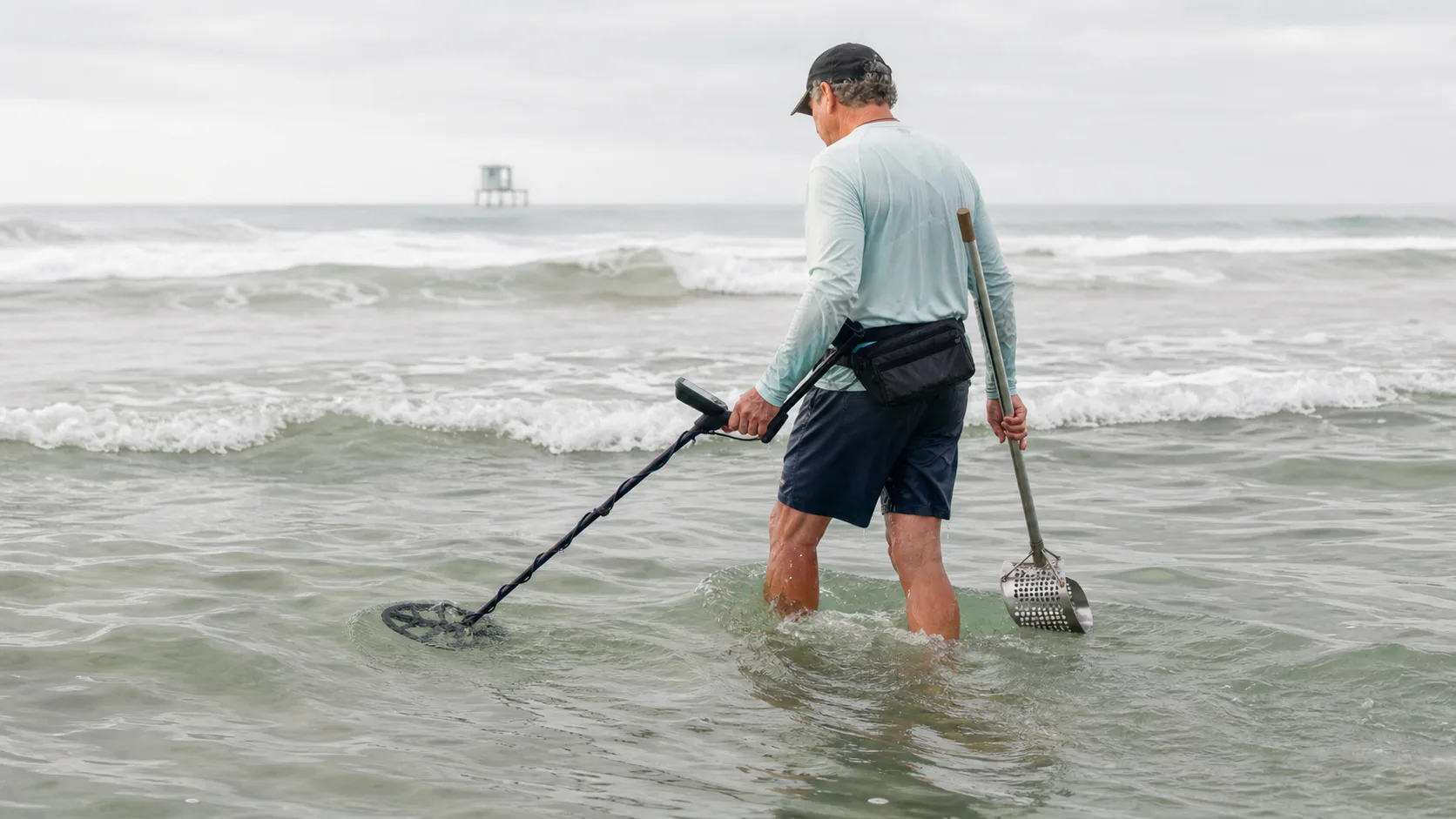
The surf is the most productive and the most demanding: you need full submersion rating, a sand scoop with a long handle, and the discipline to hunt a falling tide. Start on dry sand, work down as your machine allows.

The gear beach hunting actually requires

A long-handled sand scoop. Digging wet sand with a trowel is a losing fight — the hole fills faster than you empty it. A stainless scoop with the right hole size sifts the sand out and leaves the target.

Rinse everything in fresh water after every saltwater hunt, coil ears and shaft joints included. Salt corrosion is the leading cause of dead beach detectors, and it's entirely preventable.

05FAQ

What is the best metal detector for the beach?
The Minelab Equinox 800 — multi-frequency handles wet salt sand and it's submersible to 10 feet, so the whole beach is available to you rather than just the dry part.
Can I use any metal detector on the beach?
On dry sand, mostly yes. On wet salt sand, no — single-frequency detectors false constantly because saltwater conducts. You need a multi-frequency machine for the wet sand and surf where the good targets are.
What's the best underwater metal detector?
Among general-purpose machines, the Equinox 800 at 10 feet covers wading and shallow diving. For serious diving, dedicated pulse-induction detectors go deeper — but they trade away target ID, so you dig everything.
Do I need a waterproof metal detector for the beach?
Not for dry sand, but yes for anything below the tide line. Waves reach further than you expect, and a submersible machine removes the constant low-grade anxiety that makes people hunt badly.
Is saltwater bad for a metal detector?
Salt is corrosive to everything, including submersible machines. Rinse the detector in fresh water after every saltwater hunt — coil ears, shaft joints, and headphone connectors especially. Skipping this is how beach detectors die.
What's the best beach metal detector for kids?
A light kids' machine, used on dry sand — the Nokta Mini Hoard for younger children. Dry beach sand is the single best place to take a child detecting: shallow targets and effortless digging. See beach metal detecting with kids.
Can you metal detect on any beach?
Most public beaches allow it, but not all — some have permit requirements, seasonal restrictions, or protected dune areas that are off-limits. National seashores and protected sites usually prohibit it. Check the specific beach before you go.
Do I need a sand scoop for beach metal detecting?
For wet sand, yes — a trowel loses the fight as the hole refills. A stainless scoop with roughly 7mm holes sifts the sand out and leaves the target in the basket. See our sand scoop guide.
When is the best time to metal detect on a beach?
A falling tide, ideally after a storm. Storms strip sand and expose targets that have been buried for years, and a falling tide gives you access to wet sand that's normally underwater. Early morning after a busy weekend is the other reliable window.

Keep reading

More buying guides

  • Best Pinpointers for Metal Detecting

    The best pinpointer for metal detecting is the Garrett Pro-Pointer AT — waterproof, adjustable, and hard to lose. Probes compared for dirt, water, and gold.

  • Best Pinpointer Metal Detector for Gold

    The best pinpointer for gold is the Falcon MD20 — a very high frequency probe that finds flakes in quartz standard pinpointers miss. Gold probes compared.

  • Best Metal Detector for Kids

    The best metal detector for kids is the Nokta Mini Hoard — light enough for a small child and capable enough to find real coins. Picks by age, from 5 to teenager.

  • Best Metal Detector for Beginners

    The best metal detector for beginners is the Nokta Simplex+ — waterproof, wireless, and simple enough to use on day one. Starter, entry-level, and intermediate picks compared.

Common questions

  • How Does a Metal Detector Work?

    A metal detector works by sending a pulsing magnetic field into the ground from its coil. Metal objects react to that field by generating their own weak field, and the detector hears that echo and turns it into a tone and a number on screen.

  • Can a Metal Detector Detect Gold?

    Yes. Any metal detector will find gold — gold is metal, and gold rings, chains, and coins show up on even entry-level machines. Finding small gold nuggets in mineralized goldfields is the hard version, and that needs a high-frequency or pulse-induction detector.

  • How Much Does a Metal Detector Cost?

    A metal detector costs about $100 for a basic starter, $200–400 for a genuinely capable entry-level machine, $500–800 for mid-range multi-frequency, and $1,000–1,500 for a flagship. Most people should spend $200–400.

Get better at this

  • How to Use a Metal Detector

    How to use a metal detector: ground balance it, swing slow and low, learn your target IDs, and dig everything at first. A complete beginner's field guide.